
Turn Customer Interviews Into a Product Improvement Backlog
Convert interview notes into evidence-backed themes, opportunities, and testable backlog items without treating every request as a roadmap command.
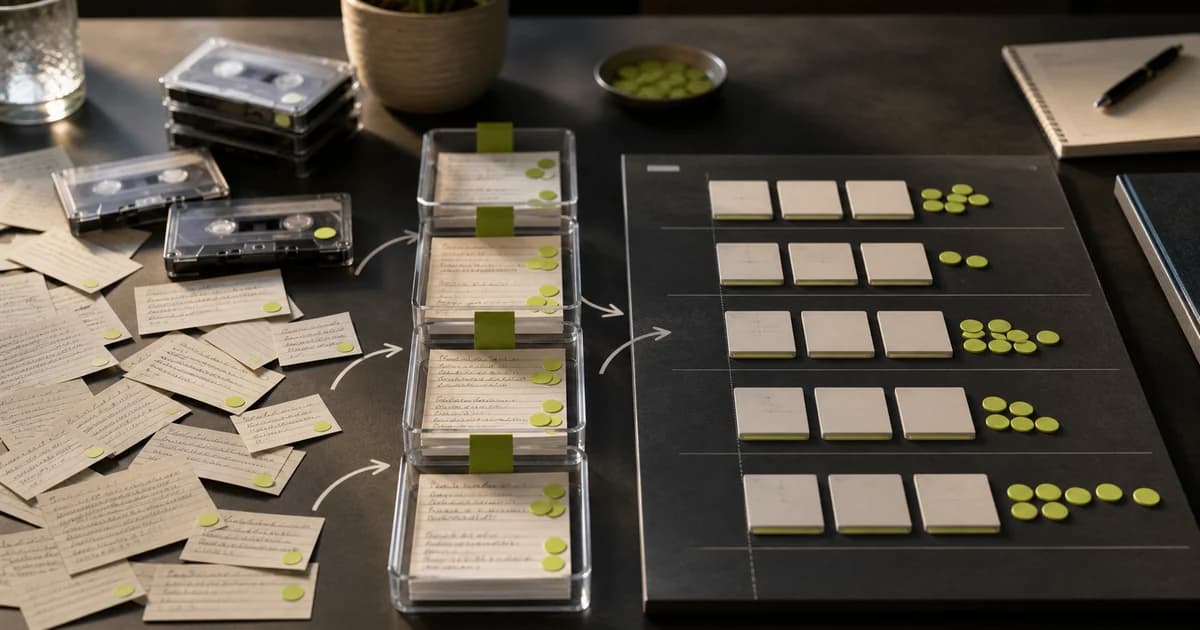
Watch the overview
3 minPrefer to read? The complete article and copyable prompts are directly below.
Customer interviews produce opinions, frustrations, workarounds, and occasional great ideas. The work is separating repeated evidence from one-off requests before anything reaches the backlog.
This guide helps you create a prioritized opportunity backlog that preserves customer evidence, separates requests from needs, and shows confidence and risk.
What you need
- Redacted notes from at least five customer interviews
- Customer segment and interview objective
- Your current product, service, constraints, and decision criteria
The workflow
1. Preserve exact evidence
Keep quotes, observed behavior, situation, and frequency. A summary that loses evidence becomes opinion.
2. Separate request from need
A customer may ask for a feature, but the underlying need may be speed, confidence, control, or fewer errors.
3. Cluster without erasing differences
Group similar needs while noting which segment, situation, and frequency produced them.
4. Prioritize learning, not volume alone
High-frequency feedback can still be low impact. Score evidence, importance, strategic fit, effort uncertainty, and risk.
Copy this working prompt
Replace every bracketed field with verified information from your business. If you do not know something, write unknown instead of guessing.
Act as a product research analyst. Turn these redacted customer interview notes into an evidence-backed opportunity backlog.

Customer segment and research objective:
[DESCRIBE]

Current product or service and constraints:
[DESCRIBE]

Interview notes:
[PASTE REDACTED NOTES WITH INTERVIEW LABELS]

Decision criteria:
[LIST CUSTOMER IMPACT, STRATEGIC FIT, RISK, EFFORT, OR OTHER CRITERIA]

Return:
1. Repeated needs with frequency and interview references
2. Exact supporting quotes
3. Customer requests separated from underlying needs
4. Contradictory evidence
5. Segment or situation differences
6. Opportunity statements in the form: Customers in [situation] need a way to [progress] because [evidence]
7. Backlog items with evidence strength, potential impact, strategic fit, effort uncertainty, and risk
8. Recommended next step: build, prototype, research, measure, or reject
9. Five follow-up questions for weak evidence

Do not invent consensus, frequency, quotes, customer intent, effort, or market size.
Run a second-pass review
The first output should not be the final answer. Use this challenge prompt to find weak evidence, hidden assumptions, or avoidable risk.
Challenge this backlog for recency bias, loud-customer bias, solution fixation, and themes supported by too few interviews. Downgrade confidence where needed.What good looks like
- Every item links to source interviews
- Needs are distinct from requested solutions
- Weak evidence leads to research, not certainty
Review before you use it
- Are contradictory interviews visible?
- Did you preserve segment context?
- Can the team explain why an item is prioritized?
Privacy and judgment guardrails
- Remove passwords, payment details, private health information, and confidential customer data before pasting anything into an AI tool.
- Treat the output as a working draft. A person remains responsible for the decision, promise, price, and final send.
- Do not let AI invent customer quotes, financial figures, legal terms, capabilities, deadlines, or proof.
Your next action
Select one high-impact, medium-confidence opportunity and run the smallest test that could change your decision.
If your AI tool still lacks the context to do this well, first Use a strong three-part prompt.